
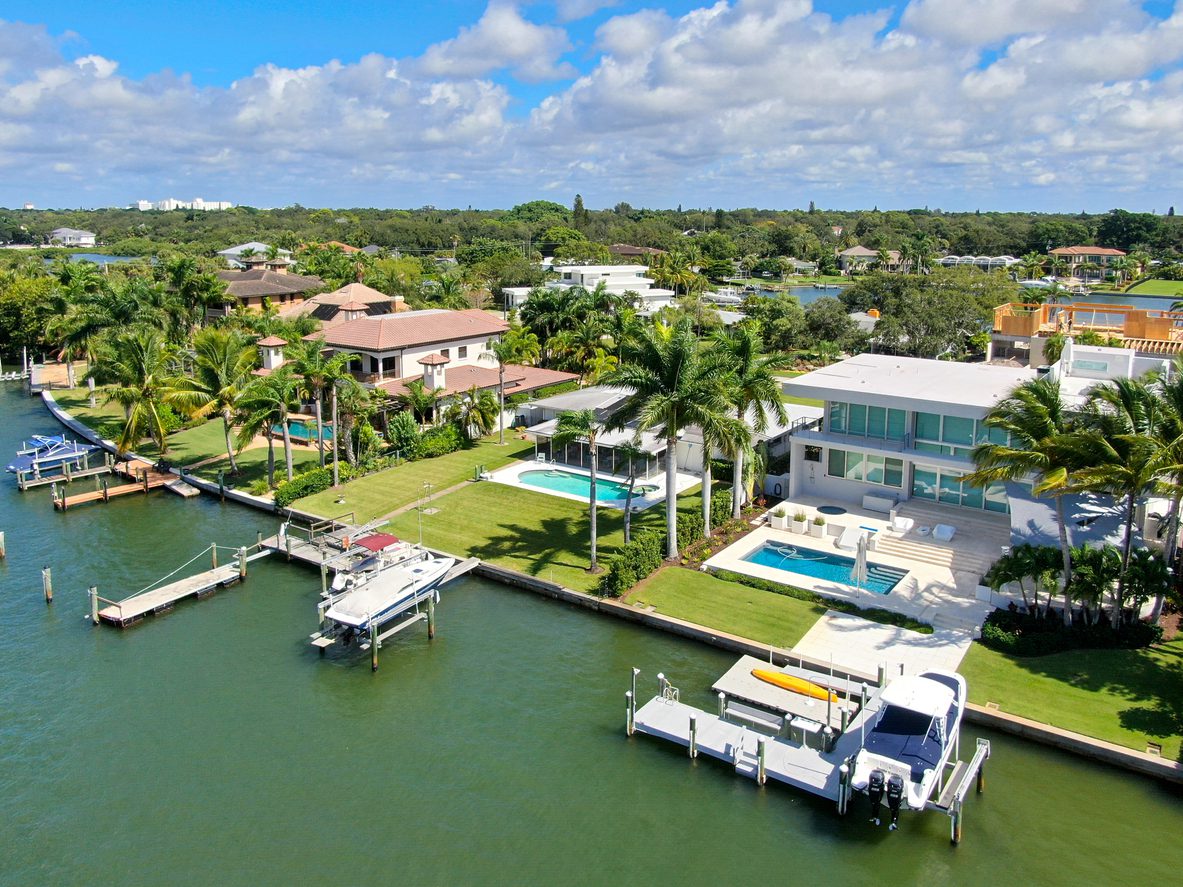
The house is only part of a waterfront project. Docks, seawalls, and boat lifts each carry their own permitting requirements, engineering standards, and construction sequencing, and homeowners who treat them as an afterthought often end up with the most frustrating delays of the entire build. Waterfront Home Dock and Seawall Planning brings these elements into the project early so the site, marine structures, and house can move forward as one coordinated build.
This guide covers what actually goes into building or replacing marine structures on a waterfront property: the environmental permitting that governs docks and seawalls, how seawall condition and design affect the rest of the site, what boat lift selection depends on, how mangrove and shoreline protections factor into the process, and how a Waterfront Custom Home Builder should sequence marine construction relative to the home itself.
Why Marine Construction Requires a Different Layer of Planning
A house sits entirely on private, upland property. A dock extends into a public waterway, and a seawall sits directly at the boundary between private land and public water, which means both are subject to a different regulatory framework than standard residential construction. The project team needs to understand this distinction clearly, because permitting for these elements can involve state and sometimes federal review, not just county building approval.
Homeowners frequently assume that because a property already has an existing dock or seawall, replacing or modifying it will be straightforward. In practice, permit requirements depend on the specific structure, proposed work, location, and applicable authorization. An experienced team will verify permit history early rather than assuming continuity.
Owners planning the broader residential portion of the project can also review Axelle Builders’ approach to waterfront custom home construction before marine and site decisions become fixed.
Environmental Resource Permits and What They Cover
In Florida, work in, on, or over surface waters, including many docks, boat lifts, and shoreline stabilization projects, may require an Environmental Resource Permit, general permit, individual permit, or verification that the activity qualifies for an exemption. The permitting pathway depends on the location and scope of the work.
For Waterfront Home Dock and Seawall Planning, that distinction matters early because the required authorization can affect both documentation and timeline. The project team should determine whether the proposed dock or lift qualifies for a simpler exemption or general permit process or requires a more detailed review.
Federal involvement can add another layer in some cases. Projects affecting waters under federal jurisdiction may also require U.S. Army Corps of Engineers authorization or fall within a coordinated state-federal permitting process. Identifying those requirements early helps prevent marine approvals from becoming disconnected from the home’s overall construction schedule.
Seawalls: Condition Assessment, Replacement, and Engineering
An existing seawall is not something to assume is sound simply because it is still standing. A professional condition assessment should happen early in the project, since a seawall nearing the end of its service life can affect site grading, drainage, access, and other design decisions.
Seawall replacement or significant repair can require its own permitting and engineering review, separate from the home’s structural design, and the construction sequencing matters. In many cases, seawall work should happen before or early in the overall construction timeline, since heavy equipment access for house construction can be complicated by marine work happening later in the same footprint.
A Waterfront Custom Home Builder should map this sequencing out at the start of the project rather than treating the seawall as a detail to handle whenever it becomes convenient.
Boat Lifts and Dock Design: What Actually Drives the Specification
Boat lift capacity needs to match the actual vessel, not a generic assumption, and undersized lifts are one of the more common and expensive mistakes on waterfront properties. Vessel specifications, including weight with fuel and gear, should be confirmed before finalizing lift capacity, since retrofitting an undersized lift after installation is far more disruptive than specifying correctly the first time.
Dock design also depends on water depth at the specific location, tidal range, access conditions, and the permitted footprint under the applicable environmental authorization. A knowledgeable builder will coordinate with a marine contractor early in design, since dock and lift specifications sometimes affect the broader site plan, particularly on narrower waterfront lots where access paths and utility routing need to be considered together with the marine structure.
Mangrove and Shoreline Vegetation Protections
Mangroves and other protected shoreline vegetation are subject to specific regulations governing trimming, alteration, and nearby construction activity. Even routine marine construction can require careful planning for how equipment and workers reach the shoreline without creating unnecessary disturbance.
This is another area where experience matters considerably. Identifying protected vegetation early allows the team to incorporate access limitations and shoreline conditions into the site plan before construction begins rather than discovering conflicts after permits or building layouts are already underway.
Sequencing Marine Construction With the Home Itself
Coordinating house construction with marine work is an often-overlooked waterfront planning task. Seawall and dock work may require the same site access as home construction. Without careful planning, both processes can conflict and cause delays.
A well-organized project usually addresses seawall repairs or replacement early. Teams can complete this work before or during the home’s initial site work. They can then schedule dock and lift installation later, after heavy home construction traffic decreases.
Discuss this sequencing during initial Waterfront Home Dock and Seawall Planning. Do not wait until construction begins to resolve these conflicts.
Insurance and Long-Term Maintenance Considerations
Marine structures carry their own insurance and maintenance considerations distinct from the home itself. Homeowners should understand the maintenance needs of seawalls, docks, and lifts. These structures face constant exposure to water, salt, and marine growth. They often require regular inspection and maintenance.
Keep clear permit documentation and conduct periodic condition assessments. These records can help with future repairs, property transactions, and insurance questions. They also help establish how marine structures were built and authorized.
Understanding Florida’s Marine Permitting Framework
The Florida Department of Environmental Protection explains that Environmental Resource Permitting covers regulated activities involving surface waters, wetlands, submerged lands, docks, piers, and shoreline stabilization. Its current Environmental Resource Permitting guidance also explains how responsibilities can be divided between DEP and Florida’s water management districts.
For certain single-family dock projects, Florida also provides processes to determine whether an activity qualifies for an exemption. DEP’s ERP e-Permitting guidance specifically identifies self-certification options for some new docks, dock replacements, and boat lift additions.
Federal coordination should also be checked rather than assumed. Florida DEP’s federal permitting coordination guidance explains that certain docks, piers, shoreline stabilization projects, and related work may fall within coordinated U.S. Army Corps of Engineers authorization pathways.
Mangrove Rules Should Be Verified Before Construction
Florida regulates mangrove trimming and alteration under the Mangrove Trimming and Preservation Act. The state’s mangrove guidance explains that red, black, and white mangroves are covered by the Act and that trimming is regulated.
Authority can also be delegated locally. Florida DEP identifies several delegated governments, including Sarasota and Pinellas counties, that administer aspects of mangrove regulation within their jurisdictions. That makes local verification an important part of Waterfront Home Dock and Seawall Planning before vegetation is trimmed or construction access is established.
Questions to Ask About Marine Construction
Ask directly how the builder handles environmental permit requirements and whether federal coordination is evaluated when it applies. Ask how they assess existing seawall condition and what triggers a recommendation for replacement versus repair. And ask how boat lift and dock specifications are determined, and whether a marine contractor is brought into the design conversation early or only once construction begins.
A Waterfront Custom Home Builder with real marine construction experience should provide specific examples from past projects. General reassurance is not enough. Detailed examples offer a stronger indication of marine construction expertise beyond residential building.
Frequently Asked Questions About Waterfront Home Dock and Seawall Planning
Does an existing dock or seawall need a new permit if I am just replacing it as is?
It may. Permit requirements depend on the structure, scope of replacement, site conditions, and the authorization that already exists. Existing structures should have their permit history reviewed before assuming a replacement qualifies automatically.
What is an Environmental Resource Permit and when is it required?
Florida’s Environmental Resource Permitting program regulates many activities involving wetlands, surface waters, docks, shoreline stabilization, and related work. Depending on the project, the required pathway may be an exemption, general permit, individual permit, or other authorization. DEP provides current dock permitting guidance for homeowners and project teams evaluating these requirements.
How do I know if my seawall needs to be replaced before building?
A professional condition assessment provides the most reliable answer. Visible surface condition does not always reveal structural integrity below the waterline. Complete the assessment early because seawall condition can affect site grading, access, drainage, and construction sequencing throughout the project.
Why does boat lift capacity matter so much during the planning stage?
An undersized lift is an expensive mistake on a waterfront property, since retrofitting capacity after installation is considerably more disruptive than specifying it correctly from the start. Actual vessel weight, including fuel and gear, should be confirmed before finalizing lift specifications.
Are there restrictions on working near mangroves during construction?
Yes. Mangrove trimming and alteration are regulated in Florida, and some activities may require a permit or the involvement of a professional mangrove trimmer. The exact requirements depend on the proposed work and jurisdiction.
Why should the dock and seawall be planned with the house?
Because marine construction and residential construction compete for site access, affect grading and drainage, and can follow separate permitting timelines. Coordinating them early reduces the risk of redesign, equipment conflicts, or avoidable construction delays.
Building Waterfront With Axelle Builders
Axelle Builders has spent more than 36 years designing and building custom homes across Southwest Florida’s waterfront communities. That experience extends beyond the house itself. Waterfront Home Dock and Seawall Planning requires coordination of marine permitting, seawall conditions, dock and boat lift requirements, and construction sequencing. Address these factors alongside residential design, not afterward.
If you are comparing builders for a waterfront project, ask how they coordinate docks, seawalls, and boat lifts. Ask these questions before comparing portfolios. The entire project depends on coordination between the home, shoreline, marine contractors, engineers, and permitting agencies. A team that manages these connections well can keep the project moving efficiently.
Planning a waterfront project and want the marine structures coordinated with the same care as the home itself? Contact Axelle Builders or call (941) 713-2303 to schedule a consultation.
Axelle Builders, 1960 Stickney Point Rd Suite 206, Sarasota, FL 34231. Serving Sarasota, Siesta Key, Longboat Key, Casey Key, Manasota Key, Anna Maria, Holmes Beach, St. Pete Beach, Fort Myers, and the surrounding Southwest Florida coast.