
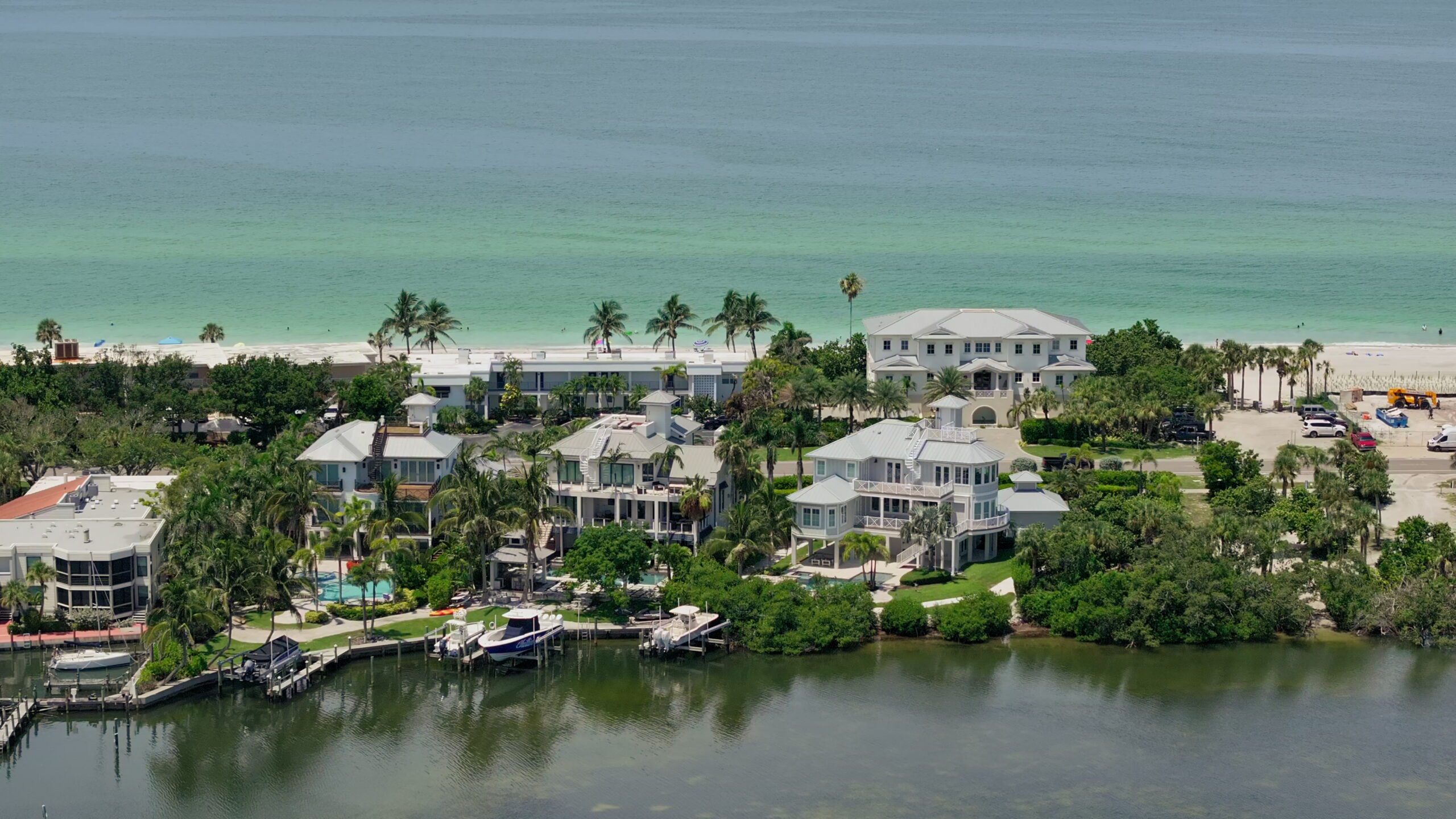
Longboat Key presents a decision that does not come up the same way on an open inland lot: whether to renovate an existing home or take it down and start over. The answer is rarely obvious, and it depends less on personal preference than on a set of local rules that most homeowners have never encountered before buying on the island. A custom home builder Longboat Key clients can rely on should be able to walk through that decision with specifics, not generalities.
This guide covers what actually drives the rebuild versus renovate decision here: the town’s substantial improvement rule and how it interacts with FEMA flood requirements, height and setback restrictions that shape what can be built on an existing footprint, the architectural review process the town requires, and how an experienced team should sequence a project around all of it.
Axelle Builders has guided homeowners through exactly this decision for more than 36 years. Review how we approach Longboat Key projects before committing to either path.
Why This Decision Looks Different on Longboat Key
On many inland lots, the rebuild versus renovate question comes down to cost and taste. On Longboat Key, it is shaped first by regulation. The town enforces a substantial improvement threshold tied to FEMA floodplain management rules, meaning that once renovation costs reach a defined percentage of the structure’s value, the entire building may be required to come into full compliance with current flood elevation standards, regardless of the homeowner’s original intent.
Getting this wrong mid-project is one of the more expensive mistakes possible on the island, since it can turn what was planned as a moderate renovation into a full elevation retrofit or a rebuild by regulatory necessity rather than choice. The rebuild vs renovate Longboat Key decision framework must begin with this calculation, not end with it.
The Substantial Improvement Rule: What Must Be Modeled First
The substantial improvement calculation compares the cost of proposed work against the market value of the existing structure, excluding land value. If that ratio crosses the town’s threshold, the home must be brought into compliance with current base flood elevation requirements, which for an older, non-elevated structure often means elevating the entire building.
A custom home builder Longboat Key homeowners can trust will run this calculation with a qualified appraiser and the town’s building department before committing to a renovation scope, not after contracts are signed. This single step determines whether a renovation stays a renovation or effectively becomes a rebuild, and it should shape the entire early planning conversation.
In many cases, an older home that has not been substantially updated turns out to be closer to the substantial improvement threshold than the homeowner expected, simply because the existing structure’s depreciated value is lower than its replacement cost would suggest. A transparent professional will walk through this calculation honestly rather than letting it surface as a surprise mid-project.
Height Restrictions, Setbacks, and Nonconforming Structures
Longboat Key enforces height limits and setback requirements that are often stricter than what exists on comparably sized mainland lots, and many older homes on the island predate current code, making them legally nonconforming. An experienced team needs to determine early whether an existing structure’s footprint, height, or setbacks could be preserved under a renovation, or whether any significant change would trigger a requirement to bring the whole structure into current compliance.
A homeowner who assumes an addition can simply extend an existing nonconforming footprint may discover that doing so forfeits the legal nonconforming status entirely, requiring the whole structure to meet current setback and height rules. A custom home builder Longboat Key clients trust should flag this possibility during the earliest design conversations rather than after a set of drawings has already been produced.
Architectural Review and Permitting Sequencing
Longboat Key requires architectural and site plan review in addition to standard building permits. Every island project must plan for this extra review layer from the start. Submission requirements and timelines differ from county permitting elsewhere in the region.
An experienced builder knows what the review board typically requests. The team can prepare submissions accordingly. This reduces back-and-forth compared with builders handling the town’s requirements for the first time.
How to Present the Analysis: Both Paths With Real Numbers
A transparent professional will lay out the rebuild vs renovate Longboat Key decision framework in plain terms: what the substantial improvement calculation shows, what a renovation would require if it stays under that threshold, and what a full rebuild would look like in cost and timeline if the numbers point that direction instead. Homeowners deserve to see both paths modeled with real numbers rather than a single recommendation presented without the underlying math.
A custom home builder Longboat Key homeowners choose should have this analysis ready before asking for a signature on anything.
What the Timeline Looks Like for Either Path
A renovation below the substantial improvement threshold usually moves faster. This applies when zoning nonconformities do not complicate the project. A rebuild requires more design, engineering, and review. The same applies when substantial improvements trigger full compliance requirements.
According to FEMA’s National Flood Insurance Program guidelines, substantial improvement determinations must be made by the local floodplain administrator before work begins, making early coordination with the building department essential regardless of which path a homeowner pursues.
A realistic timeline range for both scenarios should be provided early in the process, rather than quoting a single number that assumes the more favorable path will hold.
Questions to Ask Before Committing to a Path
Ask how they calculate the substantial improvement threshold, and whether they involve a qualified appraiser as part of that process. Ask whether the existing structure has any zoning nonconformities. Find out what preserving or losing that status means for the project. Also ask about architectural review requirements. Confirm how many review rounds comparable island projects typically require.
Then ask to see both a renovation-path budget and a rebuild-path budget modeled side by side, so the decision is made on real numbers rather than an assumption about which option is cheaper.
Frequently Asked Questions
What is the substantial improvement rule and why does it matter here?
It is a FEMA-based threshold comparing renovation costs to a structure’s existing value. Crossing that threshold can require the entire building to meet current flood elevation standards. This requirement can turn a planned renovation into a full elevation retrofit or effective rebuild. This calculation should happen early in every planning process.
Can I add onto an existing nonconforming home on Longboat Key?
It depends on the specifics of the nonconformity and the scope of the addition. In some cases, extending a nonconforming footprint can require the entire structure to come into compliance with current setback and height rules. This must be determined before design work proceeds.
Does Longboat Key require its own architectural review beyond county permitting?
Yes. The town requires architectural and site plan reviews beyond standard building permits. Its submission requirements and timelines differ from county-level reviews elsewhere in the region.
How do I know whether renovating or rebuilding makes more financial sense?
Model both paths using real numbers. Include the substantial improvement calculation and zoning nonconformity issues. Build realistic budgets for each scenario. This approach provides a clearer comparison than assuming one option costs less.
Does a rebuild always take longer than a renovation on Longboat Key?
Generally, yes. However, substantial improvement requirements can push a renovation into full compliance. This can create a timeline similar to a rebuild. Realistic ranges for both scenarios should always be provided rather than assuming the shorter path will apply.
Building on Longboat Key With Axelle Builders
Axelle Builders has spent more than 36 years designing and building custom homes across Southwest Florida. The team has extensive experience in coastal communities, including Longboat Key. As a custom home builder Longboat Key homeowners trust, we handle renovations and new construction. We model substantial improvement costs early. We also identify zoning nonconformities before design work advances. Our team guides clients through the town’s architectural review process with realistic timelines.
If you are comparing renovation and rebuild options on Longboat Key, ask builders to model both paths. Use real project numbers. Review our services page to see our process. Explore completed work in our gallery. Find more building guidance on the Axelle Builders blog.
Ready to model both paths with real numbers before making a decision? Contact Axelle Builders or call (941) 713-2303 to schedule a consultation.
Axelle Builders, 1960 Stickney Point Rd Suite 206, Sarasota, FL 34231. Serving Longboat Key, Sarasota, Siesta Key, Casey Key, Manasota Key, Anna Maria, Holmes Beach, St. Pete Beach, and the surrounding Southwest Florida coast.